
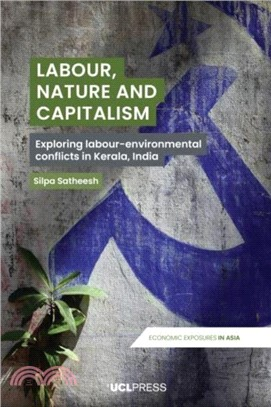
Silpa Satheesh’s Labour, Nature, and Capitalism: Exploring Labour-Environmental Conflicts in Kerala, India, contributes to the existing literature on environmental and labour studies by foregrounding the complexities of proletariat movements in the Global South. Drawing on the case of the Eloor-Edayar industrial belt, an area declared as a “toxic hotspot of global proportions by Greenpeace in 1999 (Labunska et al. 1999), Satheesh unpacks the ideological and material conflicts between labour and environmental movements, which are often simplistically portrayed as natural allies in the climate change discourse. The book offers a more nuanced analysis, centring on the political economy of development, the complicity of the state, and ideological divergence within the working class, rather than focusing solely on class-based theories.
The book is organised into eight chapters. Chapter 1 introduces the central themes by examining labour-environmental tensions in Kerala’s Eloor-Edayar industrial belt, calling for a political economy approach that extends beyond class-based analysis. Chapter 2 outlines the qualitative methodological approach chosen for the research that combines ethnography, interviews, and document analysis. Chapters 3 to 7 trace the historical emergence and ideological contestations between the trade union (Standing Council of Trade Unions – SCTU) and the environmental movement (Periyar Malineekarana Virudha Samithi–PMVS or Periyar Anti-Pollution Group), exploring themes such as the roots of industrial pollution, crony capitalism, internal class divisions, strategic framing, and the role of SCTU as a countermovement. The synthesis chapter highlights the entanglements of capitalism, state power, and labour politics, while calling for intersectional future research.
Role of the state and industrial capital
Central to the book is an exploration of the “hegemonic coalition” between the state, industry and the trade unions that work to sustain capitalist development while silencing environmental dissent. This Kerala model of “crony capitalism,” Satheesh argues, is at the same time economic and ideological, using the language of progress, employment opportunity and nationalism to justify ecological harm. A similar form of localised cronyism, which justifies environmental destruction in the name of development, has been reported by Mohankumar (2022) in the context of quarry mining in Kerala.
The state, through its regulatory institutions such as the Kerala State Pollution Control Board, often legitimises pollution by manipulating scientific knowledge. Trade unions, traditionally seen as the bastions of worker rights, are engaging in “job blackmail”, paid protests, and disinformation campaigns aimed at protecting industrial interests. In this situation, environmental movements like PMVS struggle against institutional power and financial asymmetry, often being branded as foreign-funded or anti-national.
Reframing labour-environmental conflicts in the global south
Satheesh challenges the dominance of Eurocentric and class-centric approaches to understanding environmental conflicts. For her, such approaches overlook positioning working-class actors on opposing sides of ecological struggles. In the Eloor-Edamalayar industrial cluster, while both the movements, SCTU and PMVS, draw from working-class bases, they articulate different understandings of development, pollution and justice.
In Kerala, both the trade union movement and the environmental movements are rooted in anti-capitalist and anti-state critiques. However, over time, SCTU has undergone what Satheesh calls a “class compromise”, with capital and state institutions prioritising industrial growth at the expense of ecological protection. This complicates the general understanding of labour environmental conflicts as red-green conflicts and “shifts the discussion of labour-environmental conflicts from the realm of ‘red-green conflicts’ to that of ‘red-red conflicts,’”(Satheesh 2025, 99). Red-red conflicts are ideological and strategic disputes between two groups that both claim leftist ideological legacies but whose interpretations of class and development diverge radically.
Disputes over knowledge, reality, and development
One of the most substantial contributions of the book is its analysis of framing practices. Framing is an important aspect of social movement studies. While collective action frames have received increased attention in social science (Benford and Snow 2000), analysis of environmental movements in India has mainly been restricted to resource mobilisation and the political opportunity process. In Labour, Nature, and Capitalism, Satheesh employs a social constructionist approach to demonstrate how environmental and labour movements, such as PMVS and SCTU, respectively, construct conflicting narratives about environment, development, and the very existence of pollution. These frame disputes are at the same time both ontological and ideological. The disagreements become ontological through disagreements over reality and ideological through disagreements over meaning. Each side employs science, symbolism and media to build legitimacy for their reality and meaning.
For SCTU, development is synonymous with industrial expansion and job security, while environmental harm is minimised or outright denied. By contrast, for PMVS, development is closely tied to public health, justice, and sustainability, and the polluted River Periyar is at the same time a material and symbolic site of struggle. These divergent framings reveal competing interests as well as different worldviews about the relationship between humans, labour and nature.
Concluding reflections
Shilpa Satheesh’s Labour, Nature, and Capitalism makes a significant contribution to understanding how environmental conflicts unfold in contexts marked by economic precarity and institutional complicity. It draws attention to a critical aspect of the functioning of state-labour-capital alliances, which delegitimise ecological concerns, even when those concerns emerge from the proletariat. It offers a nuanced perspective from the Global South on how material interests, ideological alignments, institutional power, and contested understandings of nature shape ecological struggles.
Methodologically, the book employs rigorous qualitative research, combining extended case methods with grounded theory. While taking an interpretive lens, Satheesh does not lose sight of material realities. The pollution of the River Periyar is not merely a discursive construct, but a lived reality, which the book repeatedly affirms. This balance between constructionist theory and realist grounding is one of the book’s intellectual strengths. While this is a researched book that challenges the accepted wisdom regarding the relationship between environmentalism, development, and class, it is not devoid of limitations. The entire research is based on a single case study, with an analytical focus primarily on class. Less attention is given to caste, gender, and intersectionality, which are essential to understanding Indian environmental politics. The best part is that the author is aware of this limitation and calls for future research to focus on these aspects.
Finally, this book offers critical tools for scholars and activists alike to navigate the complexities of labour-environment relations in the era of increased ecological crisis.
References:
Benford, R. D., & Snow, D. A. (2000). Framing processes and social movements: An overview and assessment. Annual Review of Sociology, 26(1), 611–639.
Labunska, I., Stephenson, A., Brigden, K., Stringer, R., Santillo, D., Johnston, P. A., & Ashton, J. M. (1999). Toxic hotspots: A Greenpeace investigation of Hindustan Insecticides Ltd., Udyogmandal Industrial Estate, Kerala. Greenpeace International & University of Exeter.
Mohankumar, S. (2022). Cronyism in local governments: A case study of Pallichal Gram Panchayat in Kerala. In J. Devika, S. Mohankumar, & A. Ravi (Eds.), Cronyism, development, and citizenship: A study of the effects of quarrying in Pallichal Panchayat, Thiruvananthapuram (pp. 25–66). Centre for Development Studies.
***
Sony R K is an Associate Fellow at the Sustainable Futures Collaborative, New Delhi. He works at the intersection of conservation, development, and action, with research interests spanning environmental politics and justice, as well as climate adaptation and resilience.